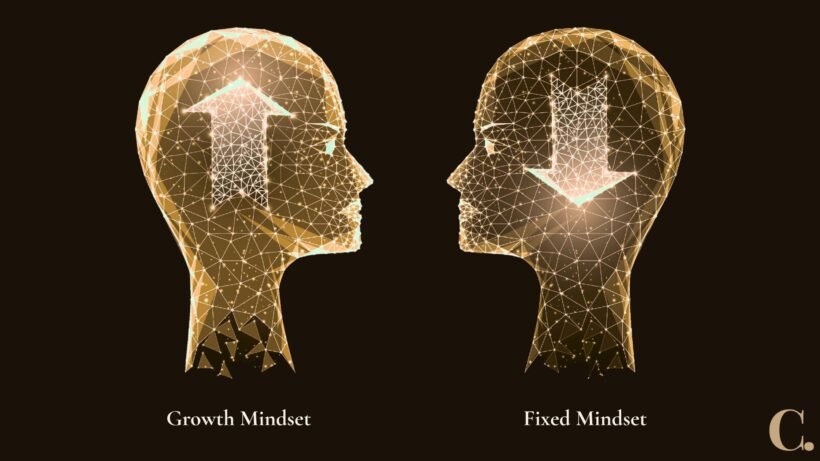

The standard advice is missing something. Here is the version your career actually needs.
The growth mindset is everywhere right now.
Business books. Leadership programmes. Corporate wellness workshops. The message is consistent: believe in your ability to grow, embrace challenges as learning opportunities, reframe failure as feedback, and you will unlock your potential.
It is good advice. For some people.
For Black professional women navigating workplaces built on the quiet assumption that we are less capable, less credible, and less deserving of the seat we worked twice as hard to earn, the standard growth mindset conversation misses something significant.
It assumes the primary obstacle to growth is internal.
The Cost of Black Excellence research tells a different story. And so do the 1,044 professionals who took part in it.
Here is the growth-mindset conversation the standard version never quite gets to.
1. Internal Beliefs vs. Imposed Doubts
The standard growth mindset framework teaches that a fixed mindset, the belief that your abilities are static, is the thing holding you back. Change the belief, change the outcome.
It is a useful framework. And it is incomplete.
Akeila, one of the research participants, named it precisely. What looks like a mindset is not always a mindset. Some of the doubts you carry came from outside you. It was put there by environments that had a vested interest in your underconfidence. By managers who questioned your judgment before you opened your mouth. By the rooms that expected less of you before you arrived.
87% of respondents in this research feel they must work harder than their colleagues just to be seen as competent. That is not a limiting belief. That is an accurate reading of the environment they are in.
The first thing to know about the growth mindset is this: distinguishing between the beliefs that are yours to change and the doubts that were imposed on you is not a distraction from the work. It is the work.
2. Not all setbacks are equal learning experiences.
The growth mindset teaches that failure is your best teacher. Embrace the setback, extract the lesson, grow.
Again: useful. And incomplete.
When a Black professional is passed over for promotion despite outperforming her peers, that is not primarily a learning opportunity. When her ideas are dismissed in the meeting and then praised when repeated by someone else, that is not feedback to be reframed. When she is told she lacks executive presence in a culture that has never seen her kind of leadership as leadership, that is not a growth edge.
Some setbacks are about your performance. Some are about the system’s unwillingness to recognise your performance. Treating them the same way leads to the most damaging conclusion possible: that the problem is always you.
The growth mindset is genuinely powerful when applied to the right object. Apply it to your skills, your strategy, your development. Be precise about which setbacks are yours to learn from and which ones are yours to name, resist, and refuse to internalise.
| Key Statistic | Impact on Black Professionals |
|---|---|
| 87% | Feel they must work significantly harder than colleagues just to be perceived as competent. |
| 89.8% | Have toned down or edited aspects of their identity (hair, voice, cultural expression) to succeed. |
| 63% | Report that their physical or emotional health has been significantly or severely impacted by their work environment. |
| 85% | Have considered leaving their roles specifically to protect their mental and emotional well-being. |
Source: The Cost of Black Excellence Research Institute (n=1,044)
3. You are not who they told you that you are.
The standard growth mindset says: stop telling yourself you are a fixed kind of person. You are capable of dramatic change.
The research asks a sharper question. Who told you who you were?
For many Black professionals, the story of who they are, and more specifically, who they are not, was written early and reinforced consistently. Too much. Too loud. Too direct. Not leadership material. Not quite right for this role. A great contributor who is not quite ready yet.
89.8% of respondents have toned down aspects of their identity to succeed professionally. Their voice. Their hair. Their emotions. Their cultural expression. Almost nine in ten women have edited themselves to fit a definition of professional that was never designed with them in mind.
That is not a growth mindset problem. That is an identity suppression problem. And the path through it is not simply believing you can be more. It is reclaiming what was always there, before the editing began.
4. Criticism from a biased source is not neutral feedback.
The growth mindset framework is clear: stop withering under criticism. See it as valuable feedback. Become hungry for it.
This advice assumes the person offering the criticism is operating from a fair baseline. That their assessment of your performance is about your performance.
Research from McKinsey and Lean In shows that Black women face the highest rates of having their judgment questioned and being mistaken for someone junior. They are more likely to be interrupted, overlooked, and held to standards that shift depending on who is watching.
When the feedback you receive is filtered through a system that undervalues you by default, the growth-mindset instruction to absorb criticism and grow from it needs a qualifier. Seek feedback from people who see you clearly. Distinguish between criticism that will make you better and criticism that will make you smaller. Not all critique is equal. The source matters.
5. The Biological Cost: Weathering and Somatic Resilience
Carol Dweck’s research on the growth mindset is genuine and significant. The finding that students who understand their brains can change, that intelligence is not fixed, achieve better outcomes: that is robust.
What is also robust is the science that shows the specific burden Black professional women carry in the workplace has measurable physiological consequences. Dr Arline Geronimus’s weathering research demonstrates that the body of a Black woman in her thirties shows biological ageing markers more consistent with a white woman in her forties. Not because of genetics. Because of the sustained, compounding stress of navigating racially hostile environments.
63% of respondents in this research report that their physical or emotional health has been significantly or severely impacted by their work environment.
The brain can change. It changes in both directions. A growth mindset supported by a healthy nervous system is one thing. A growth mindset operating within a body in a constant fight-or-flight state is another. The science that tells you to grow is the same science that tells you the conditions for growth matter.
6. Your brain can change. So can the rooms you are in.
Neuroplasticity is real. New experiences reshape neural pathways. The growth mindset creates a positive feedback loop that makes further growth more likely.
What this principle rarely acknowledges is that environments are part of the equation. Your brain changes in response to experience. And the experience of being chronically underestimated, surveilled, and required to perform at 150% for the same recognition a colleague receives at 70% is also shaping your neural pathways. The environment you are in is not a neutral backdrop to your mindset work. It is an active variable in it.
Rewiring your brain for growth requires assessing the conditions under which that rewiring is expected to happen. Some environments actively work against the process. That is not a personal failing. It is information about where to direct your energy.
7. Mindset is not the whole story.
The research is clear that mindset exists on a continuum. You are not purely fixed or purely growth-oriented. The balance shifts across situations and across your lifetime.
What the research on Black professional women adds to this is the structural context. Akeila put it plainly: it is easy for people outside of our culture to say it is your mindset that is not moving you forward, when there is evidence of trauma, evidence of environments that create exactly the kind of self-doubt being labelled as a mindset problem.
Mindset is not either/or. Neither is the explanation for why you are where you are. Your internal patterns are real. The external structures shaping your options are equally real. A framework that addresses only one half of that equation cannot produce complete solutions.
Growth requires both the internal shift and the honest reckoning with what the environment has done to make that shift harder than it should be.
8. Organisations have a mindset. And yours may not be serving you.
The standard framework acknowledges that organisations, like individuals, have a growth or fixed orientation. A growth-minded organisation harnesses the potential of every member. A fixed-minded one stays in its lane and resists the challenge of change.
The research adds a more specific observation. Some organisations have not simply failed to develop a growth mindset. They have actively invested in keeping certain people small. The culture that rewards conformity over contribution, that measures executive presence against a white male template, that sees Black women’s leadership qualities as risks to be managed rather than assets to be developed: that is not a neutral fixed mindset. That is a culture built on extraction.
85% of respondents have considered leaving their roles to protect their mental or emotional well-being. That is not a workforce with a mindset problem. That is a workforce whose organisations have failed to create the conditions for the talent they claim to want to retain.
Before investing in mindset work within a fixed organisation, it is worth asking honestly: Is this organisation capable of receiving what my growth produces? If the answer is no, the most growth-oriented decision you can make might be to build somewhere else.
9. Affirmations work. And they work better when they are rooted in truth.
The growth mindset framework recommends affirmations. An inner voice consistently directed toward growth, capability, and openness to challenge creates a positive internal environment for development.
Research on affirmations shows they are most effective when they build on existing strengths rather than contradict lived experience. An affirmation that tells you the environment is fair when you have spent years documenting that it is not will not hold. Your intelligence will reject it.
The affirmations that work for Black professional women tend to acknowledge the real without stopping there. Not “the system is fair, and I belong.” But:
“what I have navigated has produced expertise that most people in this room do not have.” Not “my confidence is limitless.” But: “I have survived every room that tried to make me smaller. I know how to be in this one.”
Rooted in reality. Oriented toward strength. Honest about the weight and clear-eyed about what you bring regardless.
10. Anyone can adopt the growth mindset. Not everyone faces the same starting conditions.
The growth mindset is available to everyone. That is genuinely true.
What is also true is that the path to activating it looks different depending on what you have been required to carry. For Black professional women, the self-awareness piece, understanding your own patterns of thinking, includes recognising which patterns were installed by the system rather than chosen by you.
The hypervigilance. The tendency to over-explain. The instinct to soften your voice before you have assessed whether the room requires it. The habit of preparing twice as hard because you learned early that your competence would be questioned, regardless.
These are not character flaws. They are intelligent adaptations to real conditions. Changing them is not about overcoming weakness. It is about deciding that the conditions that required the adaptation are not the conditions you intend to keep accepting.
The plan that follows is not a generic visualisation and affirmation. It is this: name what was imposed on you. Distinguish it from who you actually are. Build from the authentic self, not the performed one. Find the community that understands the terrain without requiring you to map it every time you arrive.
And use the research, the data, the collective testimony of over 1,000 black professionals who have walked this road, as evidence that what you have experienced is real, that the cost is documented, and that you are not navigating it alone.
That is the version of the growth mindset the standard conversation has not quite got around to telling you.
It is the version that might actually hold.
Ready to go deeper?
The Cost of Black Excellence research is building the evidence base for a different kind of conversation about Black women’s professional experiences. If you have not yet shared your experience, your voice is missing from the data already shaping real conversations.
Anonymous. Ten minutes. Every response matters.
Take the survey: https://forms.gle/yAgo9Ct7obwqSGwJ6
Join the community
The Cost of Black Excellence community is a space for Black professional women who are done doing the work alone. Research, honest conversations, and people who understand what you are navigating without requiring the full explanation every time.
Join us: https://community.costofblackexcellence.com
About the Author
Natasha Williams is the founder of The Cost of Black Excellence Research Institute, a trauma-informed coach, and the author of The Cost of Black Excellence. Her research surveyed over 1,000 professionals across four countries, examining the systemic costs paid by Black professional women navigating workplace excellence.
Website: www.costofblackexcellence.com
Key Sources
- Williams, N. The Cost of Black Excellence Research Institute: Original Survey Data, 1,039 respondents
- Dweck, C.S. Mindset: The New Psychology of Success. Random House, 2006
- Geronimus, A.T. Weathering: The Extraordinary Stress of Ordinary Life in an Unjust Society. Little, Brown Spark, 2023
- McKinsey & LeanIn: Women in the Workplace Report (annual)
- Black Women Thriving Report, Every Level Leadership, 2022


 Natasha Williams