
What it is and what it costs
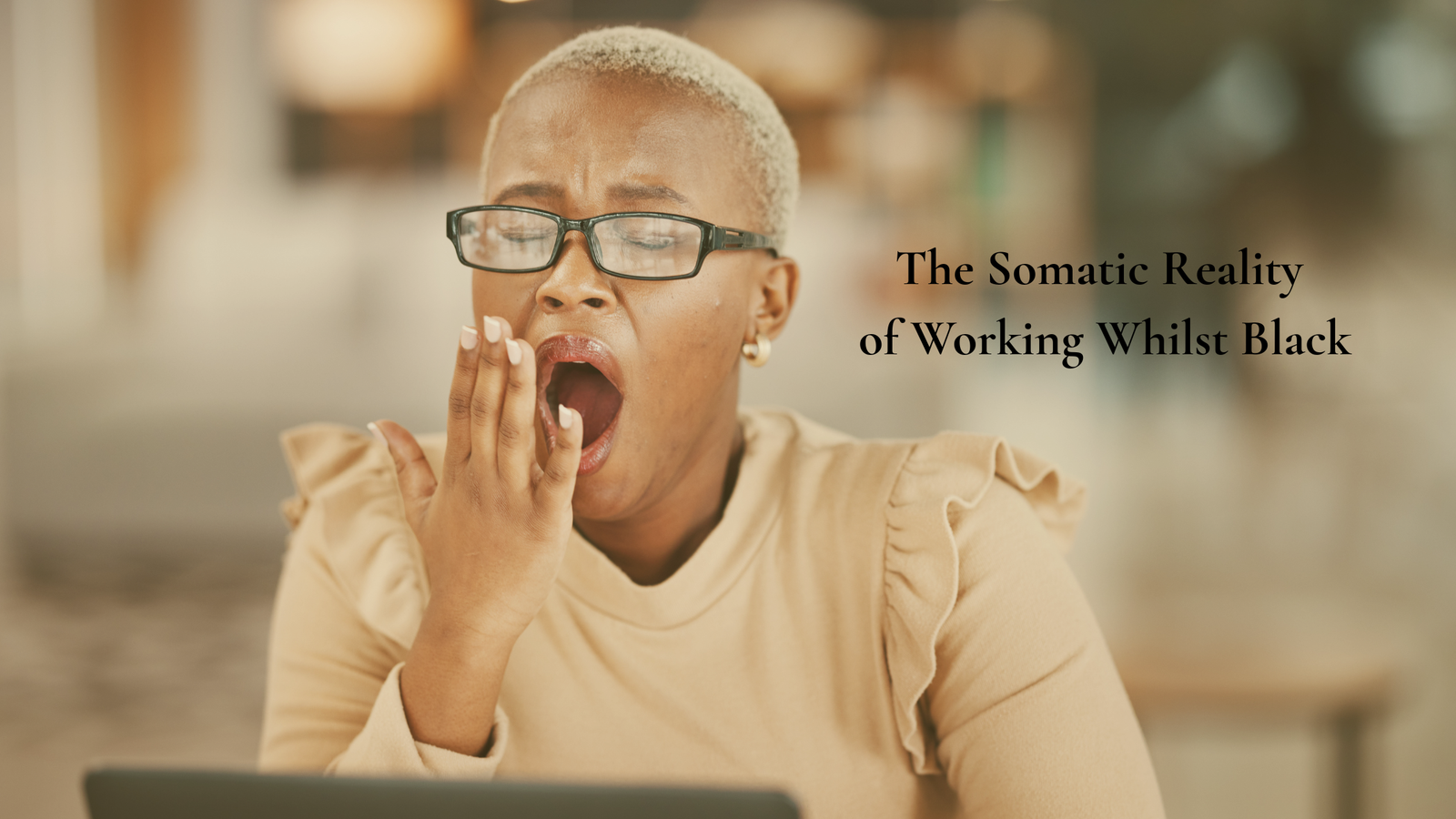
The tiredness you feel at the end of a working week is not ordinary tiredness. It does not lift fully over the weekend. It does not resolve with a holiday. Racial battle fatigue describes something more specific and more serious than general workplace stress. The Excellence Tax research documents its presence across the UK professional landscape, and what it costs the professionals carrying it.
More Than Tiredness
William A. Smith, a scholar at the University of Utah, developed the concept of racial battle fatigue in the early 2000s to describe the cumulative strain that results from sustained exposure to racism and racialised microaggressions. The term draws a deliberate parallel with combat fatigue, the psychological and physiological exhaustion experienced by soldiers in prolonged conflict. The parallel is precise. Both describe what happens to a person who remains in a threatening environment for an extended period without adequate safety, recognition, or rest.
Black professionals in corporate environments are not at war. But they are operating, day after day, in environments that require constant threat assessment, identity management, and emotional regulation that their colleagues are not asked to perform. The body responds to that demand. Over time, the response becomes a condition.
Racial battle fatigue accumulates. A single difficult meeting does not produce it. A single microaggression does not produce it. What produces it is the relentless accumulation of small and large racialised experiences across months and years, in an environment that rarely acknowledges them and almost never addresses them.
What the Research Shows
The Excellence Tax research, drawing on data from over 1,000 Black professionals across the UK, finds racial battle fatigue present at significant levels across sectors, seniority levels, and professional backgrounds.
71% of Black professionals in our study report physical symptoms they attribute directly to racialised stress at work.
These are not vague or subjective reports. The symptoms described are specific and consistent. Disrupted sleep. Persistent headaches. Elevated resting heart rate. Gastrointestinal problems. Jaw tension and teeth grinding. Chronic fatigue that sleep does not resolve. A body that has learned to stay alert and cannot easily return to a resting state.
Over half of those reporting physical symptoms say those symptoms have worsened over time.
The body adapts to a chronic threat environment. It recalibrates its baseline. What began as a stress response to specific incidents becomes a persistent physiological state. The adaptation that was designed to protect becomes the source of ongoing harm.
The cognitive picture is equally consistent. Professionals experiencing racial battle fatigue describe a narrowing of their mental bandwidth. The creative, expansive thinking that produces their best work becomes harder to access. Strategic decisions feel more effortful. The capacity for risk-taking and innovation, the qualities that organisations say they want from senior professionals, shrinks in proportion to the cognitive load the Excellence Tax is demanding.
What It Looks Like in Practice
Racial battle fatigue does not announce itself clearly. It builds gradually, and the professionals experiencing it often attribute their symptoms to other causes before they connect them to the cumulative weight of racialised workplace experiences.
The body that will not switch off
Sunday evenings carry a particular quality. The working week ended on Friday. Two days have passed. But the body has not rested. There is a low-level alertness that persists through the weekend, a readiness that the nervous system maintains regardless of whether the environment currently requires it.
Monday morning arrives and the fatigue is already present. Before a single email has been read. Before the first meeting. Before any new demand has been placed. The body carried the weight of the previous week through the weekend and arrived at the new week without having fully set it down.
This pattern is one of the most consistently reported experiences in our research. Professionals describe it across sectors and seniority levels. They describe it whether they work in organisations that present as progressive and diverse or in organisations that make no such claims. The environment producing the fatigue changes in its specific features. The physiological response follows the same pattern.
The performance that costs more than it should
You deliver. The work is strong. The client is satisfied. The project lands as planned. But the energy required to produce that outcome was greater than the outcome itself would suggest. Because the work was not all you were doing. Alongside the work, you were managing a comment made in the briefing meeting. Navigating the dynamic in the team that requires you to advocate for your own expertise before it is accepted. Absorbing the microaggression in the corridor. Pre-editing your contribution to the afternoon call so it lands without triggering a response to your tone.
The performance was excellent. The cost was invisible. And because the cost was invisible, nobody in your organisation measured it, acknowledged it, or factored it into the support they offered you.
The recovery that does not come
The holiday arrives. Two weeks. Sun, distance, removal from the environment that has been extracting from you. The first week produces genuine rest. The second week begins to restore something. And then, two days before you return, the restoration reverses. The body re-anticipates the environment. The alertness returns before the environment has even asked for it.
Our research finds that Black professionals experiencing racial battle fatigue recover more slowly and relapse more quickly than their non-Black peers. The recovery strategies that work for general burnout, rest, distance, boundary-setting, produce limited results when the source of the depletion is structural. You return to the same structure. The extraction resumes.
“I used to think I just needed a good holiday. I took four in one year. Each one helped for about a week after I got back. Then the weight came back. I eventually understood that rest was not the solution to a structural problem. The structure was.”
The Cognitive Cost
Beyond the physical, racial battle fatigue produces a specific cognitive signature that the Excellence Tax research has traced consistently across the dataset.
Hypervigilance is the dominant feature. The professional mind learns to monitor multiple channels simultaneously. The content of a conversation. The subtext beneath it. The facial expressions of the people in the room. The tone in which a comment was delivered. Whether the slight hesitation before your name was pronounced contains meaning. Whether the reassignment of the project has a racialised dimension. This monitoring is not paranoia. It is an accurate and adaptive response to an environment that has repeatedly demonstrated it carries racialised signals.
But the monitoring has a cost. Attention directed at threat assessment is attention not available for the work. Cognitive load occupied by constant environmental scanning is cognitive load not available for strategic thinking, creative problem-solving, or the kind of deep focus that produces excellent output. The Excellence Tax does not only extract performance. It degrades the conditions that make excellent performance possible.
Our research also documents a specific impact on decision-making. Professionals in a state of racial battle fatigue describe a narrowing of their decision-making bandwidth, a tendency toward caution, and a reduction in the willingness to take the professional risks that drive visible, career-building performance. The very qualities that organisations identify as markers of senior potential become harder to access under the cognitive weight of sustained racial stress.
The Psychological Impact
The psychological dimension of racial battle fatigue develops alongside the physical and cognitive. It follows a recognisable pattern across the professionals in our research.
The first stage involves hyperawareness. The professional becomes acutely attuned to racialised dynamics in their environment. They read rooms accurately and quickly. They identify patterns others miss. Their assessment of what is happening is often correct.
The second stage involves emotional exhaustion. The sustained effort of managing the emotional demands of racialised environments, the regulation, the restraint, the performance of composure under conditions that would justify a different response, depletes the emotional resources that sustain motivation, connection, and professional satisfaction.
The third stage, reached by a significant proportion of professionals in our dataset, involves a form of protective withdrawal. The professional reduces their investment in the environment. They stop bringing discretionary effort. They stop advocating for change. They manage down their expectations and narrow their ambitions to a range that the environment has demonstrated it will accommodate. This withdrawal is protective. It is also a significant loss. For the professional and for the organisation.
What the Professional Can Do With This Knowledge
Naming racial battle fatigue accurately reframes the experience. The symptoms you have been carrying are not evidence of personal fragility. They are the documented physiological and psychological response to a specific set of sustained environmental demands. That distinction changes what recovery requires.
The first step involves separating what belongs to you from what belongs to the environment. The fatigue, the hypervigilance, the disrupted sleep are responses your body and mind generated in response to an environment that demanded them. They belong to the environment, not to you. Carrying them does not mean you are weak. Developing them means you are human.
The second step involves building an accurate picture of the load you are actually carrying. Most professionals significantly underestimate the cumulative weight of their racialised workplace experiences because they have learned to absorb and move on from each individual incident. Sitting with the full picture, the frequency, the range, the duration, often produces a recognition that reframes everything that has felt like personal insufficiency as a rational response to an extraordinary demand.
The third step involves making deliberate choices about energy expenditure. Racial battle fatigue is a depletion condition. Recovery requires reducing expenditure and increasing restoration. Both are harder than they sound in an environment that continues to make racialised demands. But both are possible, and both matter.
The COBE Community creates space for this work with peers who understand the specific terrain. Join us here: [https://community.costofblackexcellence.com]
What Organisations Must Do Differently
Racial battle fatigue develops inside organisations. Organisations therefore have both the responsibility and the capacity to address it.
Measure what is actually happening. Most organisations have no data on the prevalence of racial battle fatigue among their Black employees. Engagement surveys do not capture it. Wellbeing initiatives designed for general burnout do not reach it. Creating the conditions in which Black professionals can report their experiences accurately, through anonymous qualitative data collection, through regular listening sessions led by people with the appropriate expertise, and through a genuine commitment to acting on what is found, produces the evidence base that makes structural change possible.
Stop treating symptoms in isolation. Offering an employee assistance programme to a professional experiencing racial battle fatigue without addressing the environment producing it treats the symptom and leaves the cause untouched. The professional returns to the same environment. The depletion resumes. Effective organisational response addresses the extractive processes that produce racial battle fatigue, starting with the mechanisms the Excellence Tax research has identified and documented.
Build recovery into the culture, not just the policy. Flexible working, mental health days, and access to counselling are useful. They are also insufficient on their own. Organisations committed to addressing racial battle fatigue need to examine the cultural norms that prevent Black professionals from setting boundaries, declining additional labour, and protecting their energy without professional consequence.
Create accountability for the impact of management behaviour. Much of what produces racial battle fatigue happens in the everyday interactions between managers and the professionals they manage. Tone policing. Unequal scrutiny. Microaggressions. These are management behaviours, and managers can be held accountable for them. Performance frameworks that include racialised impact as a measure of management effectiveness produce different behaviour than frameworks that do not.
One Part of a Larger Picture
Racial battle fatigue does not develop in isolation. It develops as part of the broader pattern of extraction that the Excellence Tax research documents across fifteen mechanisms. Understanding racial battle fatigue means understanding it in context: as the physiological and psychological accumulation of sustained exposure to tone policing, performance review bias, microaggressions, the double performance standard, and the daily labour of code-switching.
The harm is not located in any single interaction. It lives in the accumulation. And addressing it requires attending to the accumulation, not just the individual incidents that comprise it.
The COBE Community exists for professionals navigating this terrain. Whether you are still inside a corporate environment, considering your options, or rebuilding after leaving, you will find people here who understand what you are carrying.
Join us: [https://community.costofblackexcellence.com]
Read Next
- Back to the Workplace Healing hub: /workplace-healing
- Next article: The Weathering Effect: /workplace-healing-weathering-effect
- Explore the Corporate Survival hub: /corporate-survival
SEO Title: Racial Battle Fatigue: What It Is and What It Costs | The Excellence Tax Research Meta Description: The Excellence Tax research finds 71% of Black professionals report physical symptoms from racialised workplace stress. This article documents racial battle fatigue, its cognitive and psychological cost, and what organisations must do to address it. Focus Keyword: racial battle fatigue Black professionals Tags: RacialBattleFatigue, TheExcellenceTax, CostOfBlackExcellence, BlackProfessionals, WorkplaceHealing, WorkplaceWellbeing, RacialStress, BurnoutRecovery, BlackWomenAtWork, WorkplaceTrauma, SystemicRacism Excerpt: 71% of Black professionals in the Excellence Tax research report physical symptoms they attribute to racialised stress at work. Racial battle fatigue describes what the body and mind develop under sustained exposure to extractive workplace environments. This article names it accurately and examines what recovery requires.


 Natasha Williams