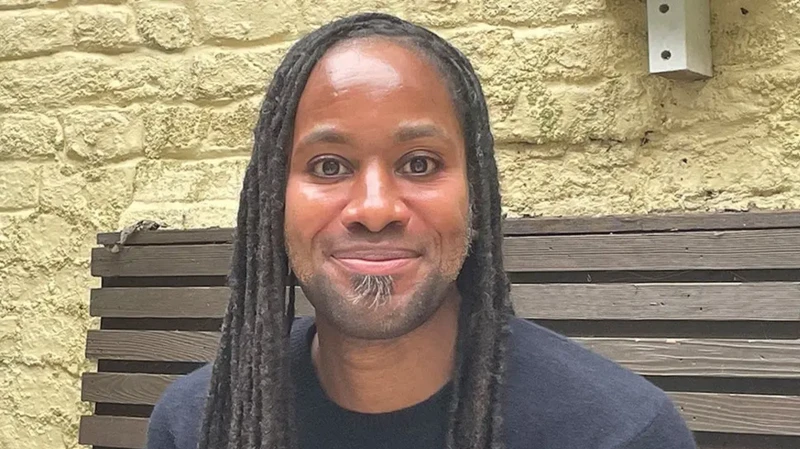

My Interview with Erin on Coffee No Cream: The Cost of Black Excellence
Some conversations stay with you long after they have ended. The kind where you leave feeling like you have finally said out loud the things you have been carrying quietly for years. My recent conversation with Erin on Coffee No Cream was exactly that.
We talked for well over an hour. We covered the research, the burnout, the building surveying years, colourism, money, community, and what it actually takes to build a life on your own terms when the systems around you were never designed with you in mind. Erin asks the kind of questions that invite honesty, and I was grateful for the space she created.
If you have not watched the full interview yet, the link is at the bottom of this post. But I wanted to write about some of what came up, because there were moments in that conversation that deserve more than a timestamp.
The Research: Why 40,000 Voices Matters
We started with the research, and specifically with the question of why I am building this study to the scale I am aiming for.
The Cost of Black Excellence™ research currently has 1,039 voices from across the UK, the United States, Canada, and Australia. The findings are already significant: 86% of participants work harder than their colleagues just to be seen as competent, 91% have considered leaving a role to protect their mental or emotional wellbeing, and 89% have experienced a significant impact on their physical or emotional health as a direct result of their work environment. These are not small numbers. These are near-universal experiences across four countries and more than 50 industries.
But 1,039 voices, powerful as they are, will only take us so far in the rooms where policy decisions get made. My goal is 40,000 participants. At that scale, this research becomes a policy paper. It becomes something that governments, regulatory bodies, and institutional funders cannot dismiss as a niche sample. It becomes something that organisations have to respond to directly, with resources, with accountability, with genuine structural change rather than the diversity theatre that passes for progress in most workplaces right now.
The Excellence Tax™, the term that emerged from the research itself when a pilot participant described feeling “taxed for existing whilst Black in white spaces,” is not just a framework for understanding individual experience. It is a mechanism for documenting collective harm. And collective harm at scale demands collective accountability at scale. That is what 40,000 voices would give us.
I also spoke with Erin about the other side of that ambition: using the research to help Black professionals access the funding and support needed to build their own enterprises. Because the data is clear that many of us are not just leaving employment out of choice. We are leaving because the extraction has become unsustainable. And when that exit is unplanned and financially precarious, we end up trading one form of exhaustion for another. The research has to do more than document the problem. It has to help create the conditions for a different kind of future.
The Surveying Years: What It Actually Cost
I have not always spoken as freely about my years in building surveying as I did in this conversation. Erin created the kind of space where the real stories came out.
Thirteen years running my own firm. Fifteen years in the sector overall. The only Black woman chartered surveyor in the whole of the West Midlands for much of that time. I want you to sit with that for a moment. An entire region. One of us.
What that looked like in practice was a version of the Excellence Tax that had physical coordinates. Turning up to a site and being asked if I was the cleaner. Clients expressing visible shock at my presence, as though the letter they had received confirming their surveyor was arriving had not quite prepared them for the reality of who I actually was. Having my authority questioned in rooms where a white male colleague of far lesser qualification would never have been asked to justify himself.
There is a particular kind of exhaustion in that. The kind where you have already done the work to earn the credentials, to build the business, to show up professionally in every sense of the word, and then you walk through a door and have to start proving yourself from the very beginning because someone’s assumption about who you are has overridden every piece of evidence in front of them.
What I shared with Erin, and what I think is worth hearing clearly, is the strategy I eventually developed: I simply walked away.
Not in anger. Not dramatically. Just quietly, deliberately, without apology. I had saved carefully. I had built financial autonomy over years of living within my means. And that financial buffer gave me something that many Black professionals in extractive environments do not have: the ability to choose who I worked with and the ability to remove clients who demonstrated racist behaviour without it costing me more than I could afford.
That is not a privilege that arrives automatically. It is something that has to be built intentionally. But it is one of the most powerful forms of protection available to us. When the financial ground beneath you is solid, when you are not one cancelled contract away from crisis, you can afford to hold standards that extractive environments will always try to erode. Your financial stability becomes a form of dignity.
Colourism: The Pain Closer to Home
There was a part of our conversation that I felt was important to address honestly, even though it required going somewhere personal and tender.
Colourism, the system of bias that privileges lighter skin tones within Black communities, is one of those topics that can generate defensiveness when we talk about it across racial lines. But it is also one that causes very real harm within our own communities, and it deserves honest examination.
I grew up with a light-skinned stepfather whose treatment of me was shaped by his own internalised beliefs about what was and was not possible for a dark-skinned Black woman. The messages I received about my worth, my potential, and my ceiling were not coming from white institutional racism in those moments. They were coming from inside my own family.
Dr Joy DeGruy’s work on Post Traumatic Slave Syndrome helps contextualise where that comes from without excusing it. The hierarchies of skin tone that slavery enforced, the ways in which proximity to whiteness was used to distribute privilege and protection within an already brutally oppressed community, did not disappear at emancipation. They were transmitted. They live in family dynamics, in community judgements, in the subtle and not-so-subtle ways we communicate to our children what they can and cannot expect for themselves.
Understanding that does not make the harm any less real. What it does is help us locate the root rather than only treating the wound. And locating the root is what makes genuine healing possible, both individually and collectively.
Community, Competition, and the Scarcity Mindset
Erin and I also talked honestly about something that does not always get aired openly: the ways in which competition, suspicion, and a scarcity mindset can show up within the Black community itself.
This is a delicate conversation because it can so easily be weaponised. Every time we name a challenge within the community, there is a risk that it gets used by those outside it to deflect from the systemic issues that created the conditions for that challenge in the first place. So let me be clear: the scarcity mindset that sometimes shows up between Black professionals is not a character flaw. It is an inheritance. It is what happens when generations of people have been placed in competition with each other for limited resources, limited opportunities, and limited seats at tables that were never designed to hold all of us.
But understanding the origin does not mean accepting the outcome. If we want to build real economic power, real institutional weight, real generational change in our communities, we have to be willing to professionalise how we do business with each other. To genuinely celebrate each other’s achievements without the flinch of scarcity. To refer work, to collaborate, to share knowledge, to show up for each other with the same energy we bring to impressing people outside our community.
This is some of the work that the COBE community is designed to support: a space where Black professionals can connect with, learn from, and genuinely invest in one another’s success. Where the default is abundance rather than competition. Where the wins circulate rather than accumulate in individual hands.
Burnout, Jamaica, and the Year I Stopped
I spoke with Erin about the burnout in a way that felt more honest than I have been in some spaces.
By 2019, my body had said enough. Years of navigating extraction in predominantly white professional environments, the hypervigilance, the constant performance of acceptability, the emotional labour that never got put on any invoice, the health impacts of sustained stress that 62% of our research participants describe as severe, all of it had accumulated to a point where there was nothing left to give.
I went to Jamaica for twelve months.
I want to say that plainly, because I know some people read that and hear irresponsibility. What it actually was, was survival. I needed to be somewhere that did not require me to perform my own existence. Somewhere I could simply be without the constant background noise of having to prove I belonged. Somewhere my body could begin to recover from what years of extraction had cost it.
Rest is not the opposite of ambition. For those of us who have spent careers operating under conditions that our research now confirms are objectively harmful, rest is a form of reclamation. The year I spent in Jamaica did not set me back. It made everything that came after it possible.
When I returned, I had clarity I had not had in years. I retrained as a trauma-informed coach. I began pursuing qualifications in Business and Organisational Psychology. I started asking the question that would eventually become the research: what is this actually costing us? And how do we put a number on it that organisations cannot ignore?
Your Worth Is Non-Negotiable
One of the threads that ran all the way through this conversation with Erin was the question of worth: how we know it, how we communicate it, and how we protect it.
I spoke about pricing, about the pattern many Black women fall into of undercharging for their expertise because years of being undervalued have distorted the internal ledger. One of the most important things a trauma-informed perspective brings to business coaching is this: your pricing is connected to your nervous system. When you have spent a career in an environment that told you, through a thousand small and large signals, that you were worth less than your peers, that message does not stay at the office door. It comes home with you. It sits in the room when you are writing a proposal. It whispers when you are deciding what to charge.
Doing that inner work, really understanding where your sense of your own value came from and what parts of it belong to you and what parts were installed by extractive systems, is not a luxury or a diversion from practical business matters. It is the most practical business matter there is.
My father-in-law used to say that the best reason to enter a traditional workplace is to learn how their systems operate, gather the necessary skills and knowledge, and then leave to build something of your own. That advice carries more weight now than it ever did. The research confirms what he understood intuitively: the extraction intensifies with seniority. The higher you rise inside an organisation that was not built for you, the more it costs. Building your own table is not just a preference. For many of us, it is a survival strategy.
A Final Word
What I carry from this conversation with Erin is a reminder of why the work matters.
When two Black women sit down and have an honest conversation about what this journey has really looked like, the barriers, the burnout, the moments of extraordinary persistence alongside the moments of extraordinary cost, something shifts. Not just for the two of them, but for every person watching or reading who recognises their own experience in what is being shared.
You were not imagining it. The research confirms you were not imagining it. And you deserve to know that, loudly and with evidence.
Watch the full interview here: www.youtube.com/watch?v=qZ6T-KTsHPg
Join the COBE Community
You do not need to have left corporate employment to join. You do not need to have reached any particular stage of recovery. You need to be a Black professional who wants to be in community with others who understand this terrain without needing it explained.
Join the CommunityAnd if you are ready to go deeper into this work, whether as a professional navigating the Excellence Tax yourself or as someone ready to build on your own terms, the COBE community is waiting for you. [Insert link here.]
Natasha Williams is the founder of The Cost of Black Excellence™ Research Institute. Her research has gathered evidence from 1,039 Black professionals across the UK, US, Canada, and Australia. She is a trauma-informed coach, workplace wellbeing strategist, and former Managing Director in building surveying and property.


 Natasha Williams